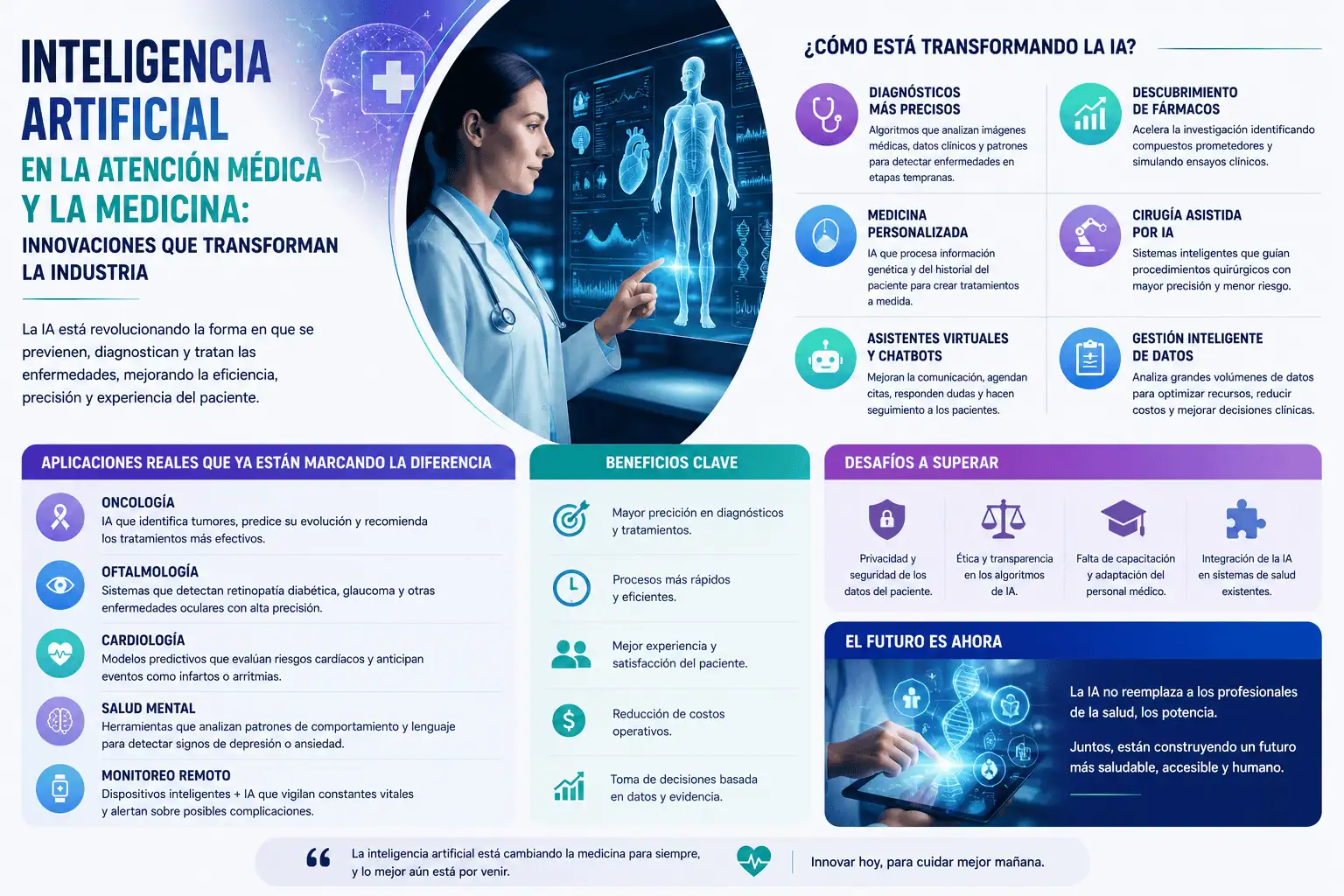
Inteligencia artificial en la atención médica y la medicina: innovaciones que transforman la industria.
I. Precisión diagnóstica: análisis de imágenes y patología mediante inteligencia artificial.
La aplicación de la inteligencia artificial (IA) en la imagenología médica está revolucionando el diagnóstico. Los algoritmos entrenados con vastos conjuntos de datos de radiografías, tomografías computarizadas, resonancias magnéticas y tomografías por emisión de positrones (PET) demuestran una precisión y velocidad superiores en la detección de anomalías sutiles que a menudo pasan desapercibidas para el ojo humano. Esto incluye la identificación temprana de tumores cancerosos, aneurismas y otras afecciones potencialmente mortales.
-
Aprendizaje profundo para la detección del cáncer: Los modelos de aprendizaje profundo, un subconjunto de la IA, son particularmente eficaces en la detección del cáncer. Por ejemplo, los algoritmos entrenados con mamografías pueden identificar microcalcificaciones y masas sospechosas indicativas de cáncer de mama, a menudo años antes de que se manifiesten clínicamente. Se están implementando sistemas de IA similares para la detección del cáncer de pulmón, analizando tomografías computarizadas para detectar pequeños nódulos con alta precisión. Los estudios han demostrado que estos sistemas de IA pueden reducir las tasas de falsos positivos, minimizando las biopsias innecesarias y la ansiedad del paciente.
-
IA en patología: La inteligencia artificial (IA) está transformando el campo de la patología al automatizar el análisis de muestras de tejido. La patología digital, combinada con algoritmos de IA, permite a los patólogos examinar rápidamente las muestras en busca de signos de enfermedad. La IA puede identificar patrones y características sutiles en células y tejidos que podrían pasar desapercibidos durante el examen manual, mejorando la precisión diagnóstica y reduciendo el tiempo necesario para el diagnóstico. Esto es especialmente valioso en el diagnóstico de enfermedades complejas como el cáncer, donde una clasificación precisa es crucial para la planificación del tratamiento. La IA también puede ayudar a cuantificar biomarcadores, predecir la respuesta al tratamiento e identificar posibles dianas farmacológicas.
-
Superando los desafíos de la IA en imágenes médicas: Si bien la IA ofrece un enorme potencial en imágenes médicas, aún existen desafíos. Uno de los principales es garantizar la generalización de los modelos de IA a diferentes poblaciones de pacientes y protocolos de imagen. Los modelos de IA entrenados con datos de un hospital pueden no tener el mismo rendimiento con datos de otro debido a las variaciones en las técnicas de adquisición de imágenes y las características demográficas de los pacientes. Para abordar esto, los investigadores están desarrollando técnicas de adaptación de dominio y aprendizaje por transferencia, lo que permite que los modelos de IA generalicen mejor a nuevos conjuntos de datos. Otro desafío es la necesidad de una IA explicable (XAI), que proporciona información sobre cómo los modelos de IA llegan a sus decisiones. Esto es crucial para generar confianza en los sistemas de IA y garantizar que los médicos puedan comprender y validar los hallazgos de la IA.
II. Medicina personalizada: Adaptación del tratamiento mediante información basada en inteligencia artificial.
AI is paving the way for personalized medicine by analyzing vast amounts of patient data to identify individual risk factors, predict treatment response, and tailor therapies to specific needs. This data includes genomic information, medical history, lifestyle factors, and environmental exposures.
-
AI for Drug Discovery and Development: The traditional drug discovery process is lengthy, expensive, and often unsuccessful. AI is accelerating this process by identifying potential drug candidates, predicting their efficacy and safety, and optimizing their design. AI algorithms can analyze large databases of chemical compounds, biological targets, and clinical trial data to identify promising drug candidates with a higher probability of success. AI can also be used to predict how patients will respond to different drugs, allowing for more targeted clinical trials and personalized treatment strategies.
-
Predictive Analytics for Disease Management: AI can be used to predict the risk of developing various diseases, such as heart disease, diabetes, and Alzheimer’s disease. By analyzing patient data, AI algorithms can identify individuals at high risk and recommend preventive measures, such as lifestyle changes or medication. AI can also be used to monitor patients with chronic diseases and predict when they are likely to experience complications, allowing for timely intervention and improved outcomes.
-
AI-Powered Treatment Optimization: AI can help clinicians optimize treatment plans for individual patients by analyzing their medical history, genomic data, and response to previous treatments. AI algorithms can identify the most effective drug combinations, dosages, and treatment schedules for each patient, maximizing the chances of success and minimizing side effects. This is particularly valuable in the treatment of complex diseases like cancer, where treatment options are numerous and the best approach varies from patient to patient.
III. Robotics and Automation: Streamlining Healthcare Operations
Robotics and automation powered by AI are transforming healthcare operations, improving efficiency, reducing costs, and enhancing patient safety.
-
Surgical Robots: AI-powered surgical robots are enhancing surgical precision, minimizing invasiveness, and reducing recovery times. These robots provide surgeons with enhanced dexterity, visualization, and control, allowing them to perform complex procedures with greater accuracy and less trauma to the patient. AI algorithms can assist surgeons in planning procedures, guiding instruments, and detecting potential complications.
-
Automated Medication Dispensing: Automated medication dispensing systems are reducing medication errors, improving inventory management, and freeing up pharmacists’ time to focus on patient counseling. These systems use AI to verify prescriptions, dispense medications accurately, and track inventory levels. They can also alert pharmacists to potential drug interactions and allergies, preventing medication errors.
-
AI-Driven Chatbots for Patient Support: AI-powered chatbots are providing patients with 24/7 access to information, support, and appointment scheduling. These chatbots can answer common questions, provide medication reminders, and connect patients with the appropriate healthcare professionals. They can also be used to monitor patients’ symptoms and provide personalized advice.
IV. Remote Patient Monitoring: Extending Care Beyond the Hospital Walls
AI is enabling remote patient monitoring, allowing healthcare providers to track patients’ vital signs, symptoms, and activity levels from afar. This is particularly valuable for patients with chronic diseases, elderly individuals, and those living in rural areas with limited access to healthcare.
-
Wearable Sensors and AI Algorithms: Wearable sensors, such as smartwatches and fitness trackers, can collect a wealth of data on patients’ health, including heart rate, blood pressure, sleep patterns, and activity levels. AI algorithms can analyze this data to identify potential health problems, such as arrhythmias, sleep apnea, and falls. They can also provide personalized recommendations for improving patients’ health and well-being.
-
Telemedicine and AI-Powered Virtual Assistants: Telemedicine, combined with AI-powered virtual assistants, is expanding access to healthcare, particularly for patients in remote areas. Virtual assistants can conduct virtual consultations, triage patients, and provide basic medical advice. They can also connect patients with specialists for more complex consultations.
-
Predicting Hospital Readmissions: AI can be used to predict which patients are at high risk of hospital readmission after discharge. By analyzing patient data, such as medical history, medications, and social determinants of health, AI algorithms can identify individuals who need extra support and intervention to prevent readmission. This can include providing patients with home health services, medication management, and social support.
V. Ethical Considerations and Future Directions
While AI holds immense promise for transforming healthcare, it is essential to address the ethical considerations associated with its use.
- Data Privacy and Security: AI relies on vast amounts of patient data, raising concerns about data privacy and security. It is crucial to implement robust security measures to protect patient data from unauthorized access and use.
- Sesgo e imparcialidad: Los algoritmos de IA pueden perpetuar y amplificar los sesgos existentes en los datos sanitarios, lo que conlleva resultados injustos o discriminatorios. Es fundamental desarrollar modelos de IA imparciales y objetivos que garanticen que todos los pacientes reciban una atención equitativa.
- Transparencia y explicabilidad: Es fundamental que los modelos de IA sean transparentes y explicables para que los profesionales clínicos comprendan cómo llegan a sus decisiones. Esto es crucial para generar confianza en los sistemas de IA y garantizar su uso responsable.
El futuro de la IA en la atención médica es prometedor. A medida que la tecnología de IA continúa avanzando, tiene el potencial de revolucionar la prestación de servicios de salud, haciéndolos más personalizados, eficientes y efectivos. Se requiere mayor investigación y desarrollo para abordar los desafíos y garantizar que la IA se utilice de manera ética y responsable para mejorar la salud y el bienestar de todos los pacientes. Esto incluye la inversión continua en investigación sobre IA, el desarrollo de marcos regulatorios sólidos y la capacitación de los profesionales de la salud sobre cómo utilizar la IA de manera efectiva. La integración de la IA en la atención médica requiere un esfuerzo colaborativo entre investigadores, médicos, legisladores y pacientes para garantizar que la IA beneficie a todos los miembros de la sociedad.