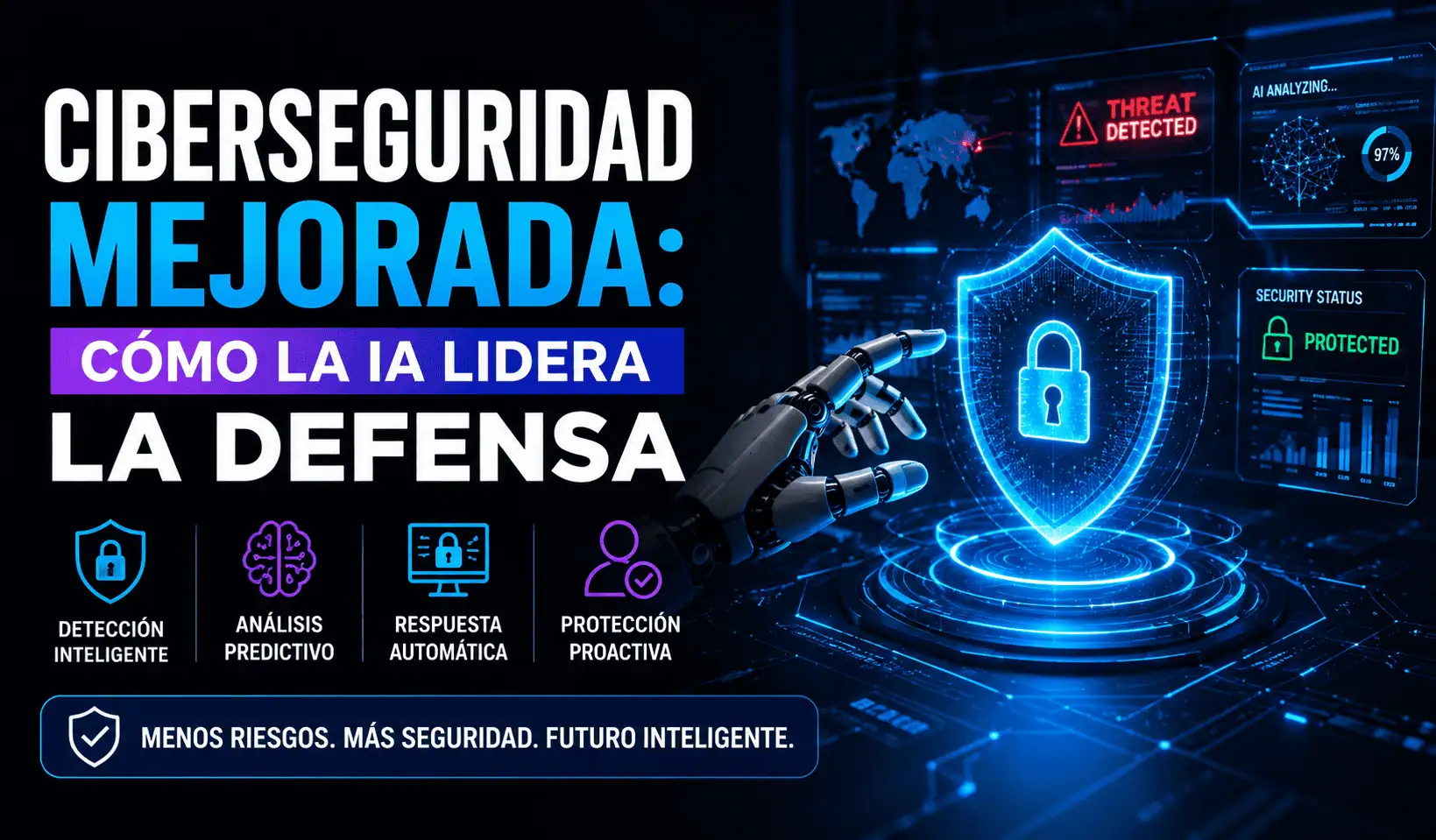
Ciberseguridad mejorada: cómo la IA lidera la defensa.
El panorama de amenazas en evolución: un llamado a la innovación.
El ámbito digital es un campo de batalla. Los ciberataques ya no son incidentes aislados; son campañas sofisticadas e implacables diseñadas para paralizar infraestructuras, robar datos confidenciales y perturbar la economía. Los métodos tradicionales de ciberseguridad, basados en la detección por firmas y respuestas reactivas, resultan cada vez más insuficientes frente al volumen, la velocidad y la sofisticación de las amenazas modernas. El malware muta rápidamente, las estafas de phishing son cada vez más convincentes y las vulnerabilidades de día cero surgen con alarmante frecuencia. Este panorama de amenazas en constante evolución exige un cambio de paradigma en la ciberseguridad, y la Inteligencia Artificial (IA) se perfila como el factor clave para esta transformación.
Detección de amenazas mediante IA: Defensa proactiva en acción
La fortaleza de la IA reside en su capacidad para analizar grandes conjuntos de datos, identificar patrones y predecir comportamientos futuros. Esta capacidad está revolucionando la detección de amenazas de diversas maneras clave.
- Detección de anomalías: Los algoritmos de IA pueden establecer una línea base de actividad normal de la red y comportamiento del usuario. Cualquier desviación de esta línea base, por sutil que sea, se marca como una posible anomalía. Esto permite a los equipos de seguridad identificar actividades sospechosas que, de otro modo, pasarían desapercibidas para los sistemas tradicionales basados en reglas. Por ejemplo, que un empleado acceda a archivos a los que normalmente no accede, o que un servidor envíe datos repentinamente a una dirección IP desconocida, activaría una alerta. Los modelos de aprendizaje automático aprenden y se adaptan continuamente a los cambios del entorno, lo que garantiza que la línea base siga siendo precisa y relevante.
- Análisis de comportamiento: Más allá de la simple detección de anomalías, el análisis de comportamiento basado en IA crea perfiles de usuarios y entidades individuales, rastreando sus acciones a lo largo del tiempo. Esto permite comprender en profundidad su comportamiento habitual y detectar cambios sutiles que podrían indicar una cuenta comprometida o una amenaza interna. Por ejemplo, que un empleado inicie sesión desde una ubicación inusual o acceda a datos confidenciales fuera del horario laboral activaría una alerta. Estos modelos de comportamiento son mucho más eficaces que las reglas estáticas para identificar ataques sofisticados que intentan mimetizarse con la actividad legítima.
- Predictive Security: AI can analyze historical attack data and identify emerging trends, allowing security teams to anticipate future attacks. This proactive approach, known as predictive security, enables organizations to strengthen their defenses before an attack even occurs. For example, by analyzing the types of phishing emails currently circulating, AI can identify vulnerable users and provide them with targeted training. Similarly, by monitoring threat intelligence feeds, AI can predict which vulnerabilities are most likely to be exploited and prioritize patching efforts.
- Automated Malware Analysis: Traditional malware analysis is a time-consuming and resource-intensive process. AI can automate this process by quickly analyzing suspicious files and identifying their malicious characteristics. Machine learning models are trained on massive datasets of known malware samples, allowing them to identify new and emerging threats with a high degree of accuracy. This reduces the time it takes to detect and respond to malware infections, minimizing the potential damage. Furthermore, AI can often identify zero-day exploits based on their behavioral similarities to known malware families.
AI in Vulnerability Management: Strengthening the Foundation
Vulnerability management is a critical aspect of cybersecurity, but it can be overwhelming for organizations with large and complex IT infrastructures. AI can streamline and enhance vulnerability management in several key areas.
- Automated Vulnerability Scanning: AI can automate the process of scanning systems for vulnerabilities, identifying weaknesses in software, hardware, and configurations. AI-powered scanners can prioritize vulnerabilities based on their severity and the likelihood of exploitation, allowing security teams to focus on the most critical issues. Furthermore, AI can learn from previous scans and improve the accuracy of future scans, reducing false positives and false negatives.
- Prioritization and Risk Assessment: Not all vulnerabilities pose the same level of risk. AI can analyze vulnerability data, threat intelligence feeds, and asset criticality information to prioritize vulnerabilities based on their potential impact on the organization. This allows security teams to focus on patching the vulnerabilities that pose the greatest threat. For example, a vulnerability in a critical system that is actively being exploited in the wild would be given a higher priority than a vulnerability in a non-critical system that is not currently being targeted.
- Predictive Patching: AI can analyze historical vulnerability data and identify patterns that predict which vulnerabilities are most likely to be exploited in the future. This allows organizations to proactively patch their systems before they are attacked, reducing their overall risk exposure. This predictive patching approach is particularly valuable for organizations that have limited resources for patching or that operate in highly regulated industries.
AI in Security Automation and Orchestration: Streamlining Incident Response
Security automation and orchestration (SAO) involves automating repetitive security tasks and coordinating security tools to improve incident response efficiency. AI is playing an increasingly important role in SAO.
- Automated Incident Response: AI can automate many of the tasks involved in incident response, such as identifying and containing infected systems, analyzing malware samples, and restoring systems to a clean state. This reduces the time it takes to respond to incidents, minimizing the potential damage. For example, if AI detects a phishing email that has successfully bypassed security controls, it can automatically quarantine the email, block the sender’s address, and notify affected users.
- Security Orchestration: AI can orchestrate different security tools to work together seamlessly, improving overall security posture. For example, AI can integrate a threat intelligence platform with a SIEM (Security Information and Event Management) system to automatically correlate threat data with security events, providing a more comprehensive view of the threat landscape. This orchestration also facilitates automated responses across multiple security tools, such as automatically updating firewall rules or isolating compromised endpoints.
- Adaptive Security: AI can continuously monitor the security environment and adjust security controls in real-time to adapt to changing threats. This adaptive security approach ensures that the organization is always protected against the latest threats. For example, if AI detects a surge in DDoS (Distributed Denial-of-Service) attacks, it can automatically increase the capacity of the network infrastructure to mitigate the impact of the attacks.
AI and the Human Element: A Collaborative Approach
While AI offers significant advantages in cybersecurity, it is not a replacement for human expertise. The most effective cybersecurity strategies combine the strengths of AI with the skills and knowledge of human security professionals.
- Augmented Intelligence: AI can augment human intelligence by providing security professionals with the insights and information they need to make better decisions. For example, AI can analyze threat data and provide security analysts with a prioritized list of potential threats, allowing them to focus their efforts on the most critical issues.
- Human-in-the-Loop AI: Human-in-the-loop AI involves incorporating human feedback into the AI training process to improve its accuracy and effectiveness. This is particularly important for complex security tasks that require human judgment. For example, a security analyst might review the results of an AI-powered malware analysis to confirm its findings or provide additional context.
- Addressing the Skills Gap: AI can help to address the cybersecurity skills gap by automating many of the routine tasks that are currently performed by human security professionals. This frees up security professionals to focus on more complex and strategic tasks, such as threat hunting and incident response. AI can also provide security professionals with training and guidance, helping them to develop the skills they need to stay ahead of the evolving threat landscape.
The Future of AI in Cybersecurity: Towards Autonomous Defense
The future of AI in cybersecurity is likely to involve even greater levels of automation and autonomy. AI-powered security systems will be able to detect and respond to threats in real-time, without human intervention. This will require the development of more sophisticated AI algorithms that can learn from experience and adapt to changing environments.
- Autonomous Threat Hunting: AI will be able to proactively hunt for threats within the network, identifying and mitigating them before they can cause damage. This will involve the use of advanced machine learning techniques to analyze network traffic, system logs, and other data sources to identify suspicious patterns and anomalies.
- Self-Healing Systems: AI will be able to automatically repair and restore systems that have been compromised by cyberattacks. This will involve the use of AI-powered automation tools to isolate infected systems, remove malware, and restore data from backups.
- AI-Driven Security Awareness Training: AI can personalize security awareness training for individual users, tailoring the content and delivery to their specific needs and vulnerabilities. This can improve the effectiveness of security awareness training and reduce the risk of human error.
Challenges and Considerations
While AI offers immense potential for enhancing cybersecurity, certain challenges need to be addressed:
- Data Quality and Bias: AI models are only as good as the data they are trained on. Biased or incomplete data can lead to inaccurate or unreliable results. Ensuring data quality and mitigating bias are crucial for deploying effective AI-powered security solutions.
- Explicabilidad y transparencia: Comprender cómo los modelos de IA llegan a sus decisiones es fundamental para generar confianza y garantizar la rendición de cuentas. Sin embargo, muchos modelos de IA son “cajas negras”, lo que dificulta comprender su razonamiento. El desarrollo de técnicas de IA explicable (XAI) es crucial para promover la transparencia y la confianza en los sistemas de seguridad basados en IA.
- La carrera armamentística de la IA: Los ciberdelincuentes también están desarrollando herramientas basadas en IA para potenciar sus ataques. Esto genera una carrera armamentística en la que tanto defensores como atacantes desarrollan constantemente técnicas de IA nuevas y más sofisticadas. Para mantenerse a la vanguardia, se requiere innovación continua e inversión en investigación y desarrollo de IA.
- Consideraciones éticas: Los sistemas de seguridad basados en IA plantean diversas consideraciones éticas, como la privacidad, los sesgos y la responsabilidad. Es fundamental desarrollar e implementar soluciones de seguridad con IA de forma responsable y ética. Esto incluye garantizar que los modelos de IA se utilicen de manera justa y transparente, y que no discriminen a ningún grupo en particular.
El poder transformador de la IA es innegable. Al adoptar la IA y abordar sus desafíos, las organizaciones pueden mejorar significativamente su ciberseguridad y defenderse del panorama de amenazas en constante evolución. Este enfoque proactivo y adaptativo ya no es un lujo, sino una necesidad para sobrevivir en la era digital.