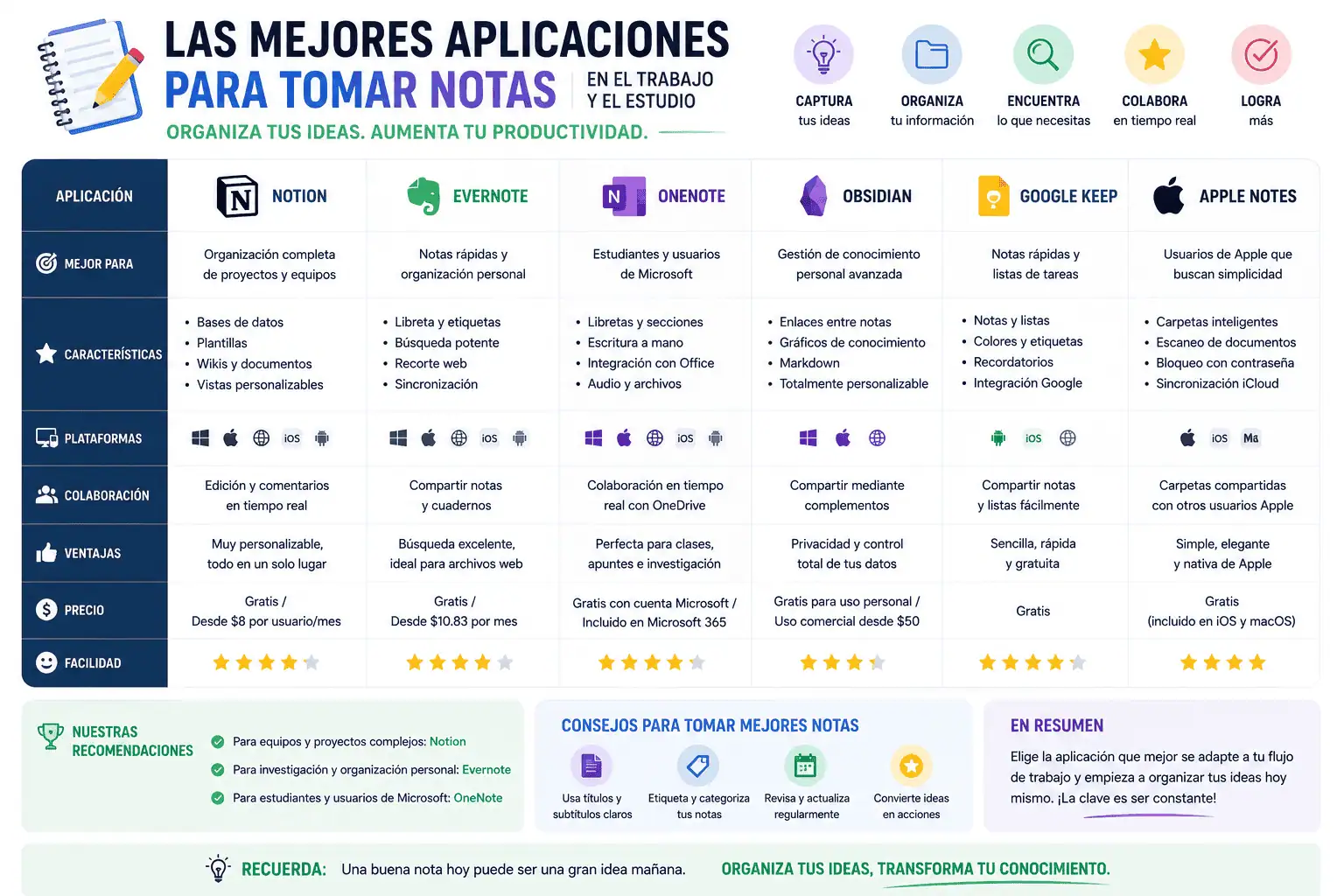
Las mejores aplicaciones para tomar notas en el trabajo y el estudio: organiza tus ideas.
I. La revolución de la toma de notas digitales: Un cambio del papel al papel.
El humilde cuaderno y el bolígrafo, que alguna vez fueron la base de la captura de información, están cediendo terreno cada vez más a las aplicaciones digitales para tomar notas. Esta transición no es solo una cuestión de comodidad; representa un cambio fundamental en la forma en que organizamos, accedemos y utilizamos la información. Las notas digitales ofrecen una capacidad de búsqueda sin precedentes, una integración perfecta con otras herramientas y la posibilidad de colaborar en tiempo real, características que en gran medida no están disponibles en sus contrapartes analógicas. Tanto para los profesionales que gestionan múltiples proyectos como para los estudiantes que se enfrentan a cursos complejos, estas aplicaciones se están convirtiendo en herramientas indispensables para la productividad y la gestión del conocimiento.
II. Características clave a tener en cuenta al elegir una aplicación para tomar notas
Elegir la “mejor” aplicación para tomar notas es subjetivo y depende en gran medida de las necesidades y flujos de trabajo individuales. Sin embargo, varias características clave obtienen consistentemente altas calificaciones en satisfacción del usuario y efectividad general:
- Compatibilidad de plataformas: ¿La aplicación funciona sin problemas en todos tus dispositivos (ordenador de escritorio, portátil, tableta, teléfono)? La accesibilidad multiplataforma es fundamental para capturar ideas sobre la marcha y acceder a ellas desde cualquier lugar.
- Organización y estructura: ¿Qué tan bien te permite la aplicación categorizar y estructurar tus notas? Funciones como libretas, etiquetas, carpetas y organización jerárquica son esenciales para mantener un sistema claro y lógico.
- Formato de texto enriquecido: Además del texto básico, ¿puede formatear sus notas con títulos, viñetas, listas numeradas, negrita, cursiva y diferentes estilos de fuente? Un formato robusto mejora la legibilidad y resalta la información clave.
- Compatibilidad multimedia: ¿Puedes insertar imágenes, grabaciones de audio, vídeos y otros elementos multimedia en tus apuntes? Esto resulta especialmente útil para quienes aprenden visualmente y para quienes necesitan recopilar información de diversas fuentes.
- Funcionalidad de búsqueda: ¿Qué tan efectiva es la función de búsqueda de la aplicación? La capacidad de encontrar rápidamente información específica dentro de una vasta biblioteca de notas es fundamental.
- Funciones de colaboración: ¿Es posible compartir notas con otros, colaborar en tiempo real y asignar tareas? Esto es fundamental para proyectos en equipo y aprendizaje colaborativo.
- Acceso sin conexión: ¿Puedes acceder y editar tus notas incluso sin conexión a internet? Esto es fundamental para trabajar en zonas con conectividad limitada o inexistente.
- Sincronización: ¿Con qué fiabilidad sincroniza la aplicación tus notas entre dispositivos? La sincronización perfecta garantiza que tus datos estén siempre actualizados y accesibles.
- Modelo de precios y suscripción: ¿La aplicación es gratuita, de suscripción o de compra única? Considere el costo y si las funciones justifican el precio.
- Security and Privacy: How secure is your data? Does the app offer encryption and other security measures to protect your notes from unauthorized access?
III. Top Note-Taking Apps for Work:
- Microsoft OneNote: A versatile and free note-taking app that integrates seamlessly with the Microsoft Office suite. OneNote’s flexible canvas allows users to organize notes in notebooks, sections, and pages, and its robust search functionality makes it easy to find specific information. Key features include audio recording, handwriting recognition, and the ability to embed files. Its integration with Microsoft Teams makes it excellent for collaborative projects. The cross-platform accessibility and generous free tier make it a popular choice for professionals.
- Evernote: A long-standing favorite in the note-taking world, Evernote offers a powerful set of features for organizing and managing information. Its web clipper allows users to save articles and web pages directly to their notebooks, and its optical character recognition (OCR) technology makes text within images searchable. Evernote’s tagging system and advanced search filters provide granular control over note organization. While its free tier has limitations, the premium plans offer enhanced storage, collaboration features, and offline access.
- Notion: An all-in-one workspace that combines note-taking with project management, task management, and database functionalities. Notion’s flexible building blocks allow users to create custom layouts and workflows, making it ideal for managing complex projects and organizing information in a structured way. Its collaboration features and extensive template library make it a powerful tool for teams. The learning curve can be steep, but the potential for customization and organization is immense.
- Google Keep: A simple and intuitive note-taking app that integrates seamlessly with the Google ecosystem. Google Keep’s color-coding system and tagging features make it easy to organize notes, and its voice recording feature allows users to capture ideas on the go. Its collaborative features and integration with Google Docs and Google Calendar make it a useful tool for teams. While it lacks the advanced features of some other note-taking apps, its simplicity and ease of use make it a great choice for those who need a quick and convenient way to capture and organize ideas.
- Bear: A beautifully designed note-taking app exclusively for Apple devices. Bear’s Markdown support allows users to format notes with ease, and its tagging system provides a flexible way to organize information. Its focus mode eliminates distractions, allowing users to concentrate on writing. While it lacks cross-platform compatibility and collaboration features, its elegant design and powerful features make it a popular choice for Mac and iOS users.
IV. Top Note-Taking Apps for Study:
- Notability: A powerful note-taking app designed specifically for students. Notability allows users to annotate PDFs, record lectures, and create interactive notes with handwritten text, drawings, and audio recordings. Its split-screen mode allows users to view two notes simultaneously, making it easy to compare and contrast information. Notability’s cloud sync ensures that notes are accessible across all devices. The one-time purchase price can be a deterrent, but the app’s comprehensive features make it a worthwhile investment for serious students.
- GoodNotes: Another popular note-taking app for students, GoodNotes offers similar features to Notability, including PDF annotation, handwriting recognition, and audio recording. GoodNotes’ customizable templates allow users to create visually appealing notes, and its search functionality makes it easy to find specific information. Its collaboration features allow students to share notes with classmates. Like Notability, GoodNotes is a one-time purchase.
- Evernote (Student Edition): Evernote’s robust organization features and web clipping capabilities make it a valuable tool for students. The ability to save articles, websites, and PDFs directly to Evernote notebooks makes it easy to gather research materials, and its tagging system allows for granular control over note organization. Its OCR technology allows students to search for text within images of handwritten notes. The student edition of Evernote offers discounted pricing for eligible students.
- Simplenote: A lightweight and free note-taking app that is perfect for capturing quick notes and ideas. Simplenote’s distraction-free interface allows students to focus on writing, and its tagging system makes it easy to organize notes. Its real-time synchronization ensures that notes are accessible across all devices. While it lacks the advanced features of some other note-taking apps, its simplicity and ease of use make it a great choice for students who need a quick and convenient way to capture and organize ideas.
- Bear (for Mac/iOS Students): Similar to its professional appeal, Bear’s clean interface and distraction-free writing environment make it an excellent tool for focused studying, particularly for writing essays or research papers, if the user operates within the Apple ecosystem.
V. Optimizing Your Note-Taking Workflow
Regardless of the app you choose, adopting effective note-taking strategies is crucial for maximizing its potential. Consider the following tips:
- Active Listening/Reading: Engage actively with the material you’re studying or working with. Don’t just passively copy information; summarize, paraphrase, and connect concepts to your existing knowledge.
- Método Cornell: Divide tu hoja de apuntes en tres secciones: notas, pistas y resumen. Toma notas en la sección principal, anota palabras clave y preguntas en la columna de pistas y resume los puntos principales en la parte inferior.
- Mapas mentales: Utiliza mapas mentales para organizar visualmente la información y conectar conceptos relacionados. Comienza con una idea central y desarrolla temas y subtemas relacionados.
- Utilice las etiquetas estratégicamente: desarrolle un sistema de etiquetado coherente para categorizar sus notas y que le resulte más fácil encontrarlas.
- Repase con regularidad: Repase sus apuntes periódicamente para reforzar el aprendizaje e identificar lagunas de conocimiento.
VI. El futuro de las aplicaciones para tomar notas
La evolución de las aplicaciones para tomar notas es constante. Tecnologías emergentes como la inteligencia artificial (IA) y el aprendizaje automático (AA) están a punto de revolucionar la forma en que capturamos, organizamos y utilizamos la información. Las aplicaciones con IA podrían resumir automáticamente las notas, identificar conceptos clave e incluso predecir futuras necesidades de aprendizaje. La integración con la realidad virtual (RV) y la realidad aumentada (RA) podría crear experiencias de aprendizaje inmersivas y transformar nuestra interacción con la información. A medida que la tecnología siga avanzando, es probable que las aplicaciones para tomar notas se conviertan en herramientas aún más potentes e imprescindibles para el trabajo y el estudio.