AI for Video Editing and Animation: A Creative Revolution
The landscape of video editing and animation is undergoing a profound transformation, spearheaded by the rapid advancements in Artificial Intelligence (AI). No longer relegated to futuristic fantasies, AI tools are now practical, accessible, and revolutionizing workflows for professionals and amateurs alike. From automating tedious tasks to unlocking entirely new creative possibilities, AI is becoming an indispensable partner in the visual storytelling process.
AI-Powered Automation: Streamlining the Editing Workflow
Traditionally, video editing involves countless hours spent on meticulous tasks like cutting, trimming, color correcting, and adding visual effects. AI is significantly reducing this burden through automation, allowing editors to focus on the more artistic and strategic aspects of their work.
-
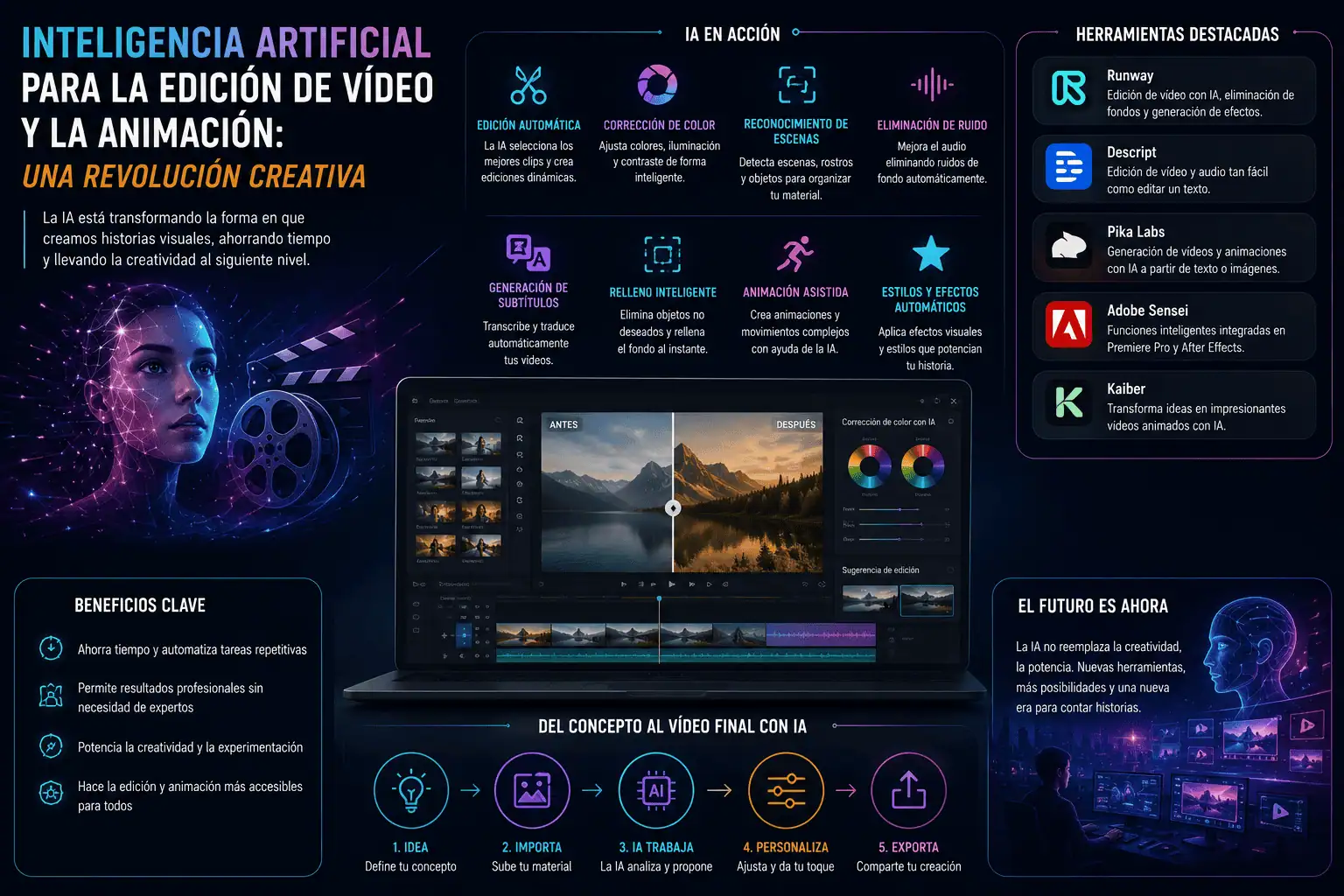
Scene Detection and Auto-Cutting: AI algorithms can analyze video footage to automatically detect scene changes, identify key moments, and suggest potential cut points. Tools like Adobe Premiere Pro’s Scene Edit Detection, powered by Adobe Sensei, analyze video streams to identify edit points and add cuts, saving editors hours of manual scrubbing and marking. This feature is particularly useful for working with long recordings, such as lectures or sporting events.
-
Intelligent Footage Organization: AI can categorize and tag video clips based on content, objects, and even emotions detected in the scene. This allows editors to quickly search for specific footage, streamlining the process of assembling complex sequences. Imagine searching for “footage with a smiling person near a lake” and instantly retrieving all relevant clips.
-
Automated Subtitle Generation and Transcription: Transcribing audio and adding subtitles is a time-consuming but crucial process for accessibility and global reach. AI-powered tools like Descript and Happy Scribe automate this process with remarkable accuracy, often surpassing human transcribers. They also allow for easy editing of the generated transcript, which automatically updates the subtitles.
-
Smart Reframing and Cropping: With the rise of mobile-first content, videos need to be optimized for various aspect ratios. AI can automatically reframe videos for different platforms (e.g., Instagram stories, TikTok, YouTube shorts) ensuring the most important elements of the scene remain in view. This eliminates the need for manual cropping and repositioning, saving significant time and effort.
-
Background Removal and Replacement: Removing or replacing backgrounds is a common task in video editing, often requiring complex rotoscoping techniques. AI-powered tools can now automatically detect and isolate foreground objects, allowing for seamless background removal or replacement with minimal effort. This opens up creative possibilities for compositing and visual effects.
AI-Enhanced Creativity: Pushing the Boundaries of Visual Storytelling
Beyond automation, AI is also empowering artists and animators to explore new creative avenues, enabling them to realize visions that were previously impossible or prohibitively expensive.
-
Style Transfer: AI algorithms can transfer the artistic style of one image or video onto another. For example, you could transform your video footage to resemble a painting by Van Gogh or a sketch by Leonardo da Vinci. This opens up exciting possibilities for creating unique and visually stunning aesthetics.
-
Deepfakes and Facial Animation: While controversial, deepfake technology demonstrates the power of AI to manipulate and generate realistic faces. In animation, this can be used to create realistic facial expressions and lip-syncing, reducing the need for extensive manual animation. However, ethical considerations surrounding deepfakes are paramount.
-
Motion Capture and Animation: AI can streamline the motion capture process by analyzing video footage and automatically generating 3D animation data. This eliminates the need for expensive motion capture suits and specialized equipment, making animation more accessible to independent creators. AI can also be used to refine and improve existing motion capture data, resulting in more realistic and fluid animations.
-
AI-Generated Content (Text-to-Video and Image-to-Video): Emerging AI models are capable of generating video content from text prompts or images. While still in its early stages, this technology holds immense potential for creating customized animations and visual effects. Imagine describing a scene and having AI generate a short video clip based on your description.
-
Upscaling and Enhancement: AI algorithms can enhance the resolution and quality of low-resolution video footage, making it suitable for modern displays and broadcast standards. This is particularly useful for restoring old footage or working with archival material. AI can also reduce noise, sharpen details, and improve overall image quality.
-
Color Grading and Correction: AI-powered color grading tools can analyze video footage and automatically suggest color adjustments to achieve a desired mood or style. This simplifies the color grading process and helps editors achieve professional-looking results quickly. AI can also identify and correct color imbalances, ensuring consistent color across different shots.
Specific AI Tools and Software in Video Editing and Animation:
-
Adobe Premiere Pro and After Effects (Adobe Sensei): Adobe’s flagship video editing and animation software integrate AI features powered by Adobe Sensei, including scene edit detection, auto-reframe, and content-aware fill.
-
RunwayML: A platform that provides a variety of AI tools for creative tasks, including video editing, image generation, and style transfer.
-
Descript: An audio and video editing tool that uses AI for transcription, subtitle generation, and audio cleanup.
-
Topaz Video Enhance AI: A software specifically designed for upscaling and enhancing video resolution using AI algorithms.
-
Synthesia: An AI video generation platform that allows users to create videos with realistic AI avatars from text scripts.
-
Motion AI: Offers AI-powered motion capture and animation tools.
-
Lumen5: Focuses on creating video content for social media using AI.
Challenges and Future Directions:
Despite the immense potential of AI in video editing and animation, there are still challenges to overcome.
-
Computational Power: AI algorithms, particularly those used for deep learning, require significant computational resources. This can be a barrier to entry for independent creators and small studios.
-
Data Dependency: AI models are trained on large datasets of video and images. The quality and diversity of these datasets directly impact the performance and accuracy of the AI.
-
Ethical Considerations: The use of AI in video editing raises ethical concerns, particularly regarding deepfakes, misinformation, and copyright infringement.
-
Creative Control: While AI can automate tasks and suggest creative ideas, it’s important for artists to maintain creative control and avoid relying solely on AI-generated content.
Looking ahead, AI will continue to play an increasingly significant role in video editing and animation. We can expect to see even more sophisticated AI tools that can:
- Generate photorealistic 3D models and environments.
- Create highly realistic and expressive AI avatars.
- Compose original music and sound effects based on video content.
- Automatically generate entire video stories from text prompts.
The future of video editing and animation is a collaborative one, where human creativity and AI intelligence work together to unlock new possibilities in visual storytelling.