Análisis de portátiles 2026: Estudiantes vs. Profesionales – Un análisis exhaustivo
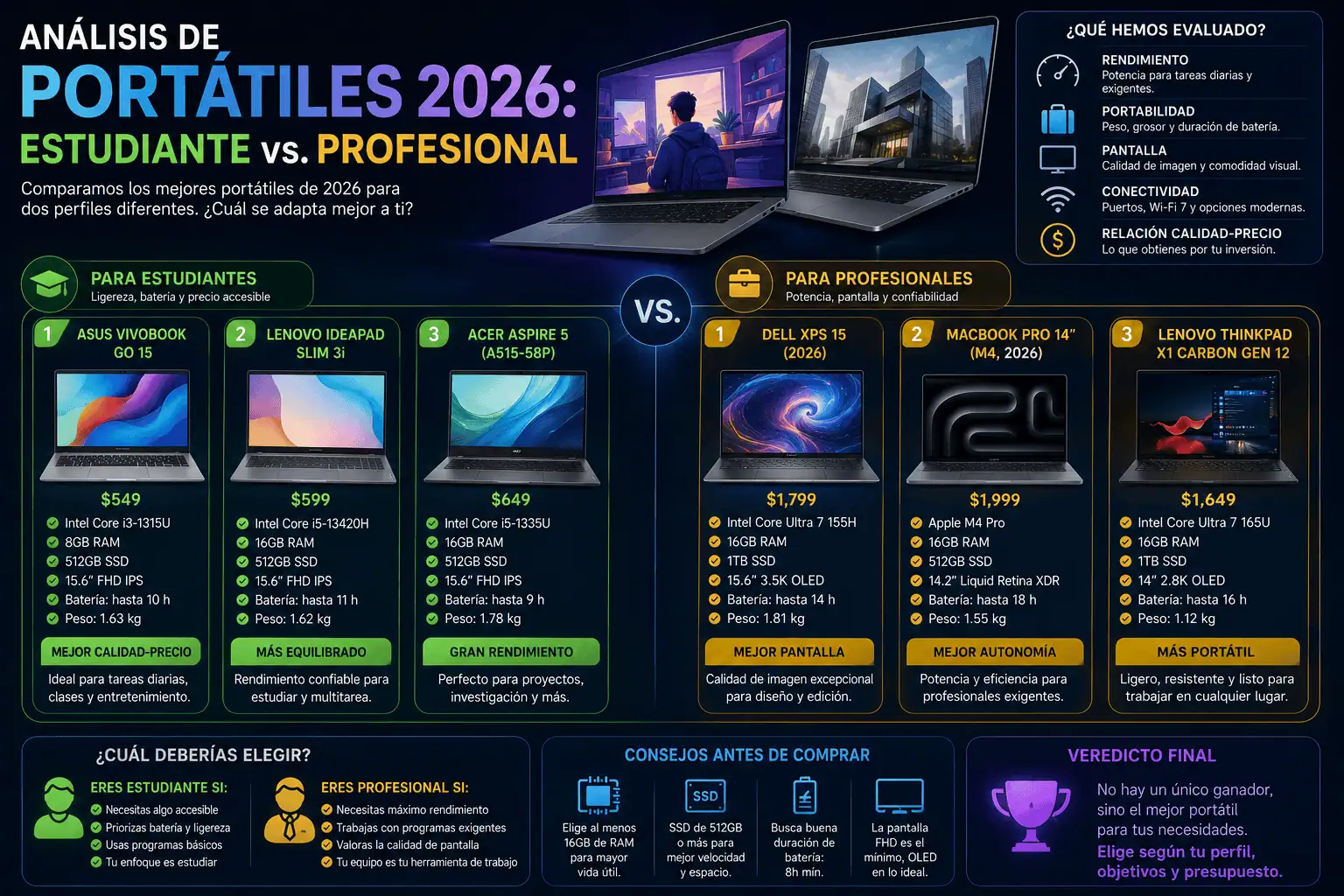
El panorama de los portátiles en 2026 es un mosaico dinámico tejido con avances tecnológicos. Sin embargo, elegir el equipo adecuado sigue siendo una decisión crucial, especialmente para estudiantes y profesionales, cuyas necesidades suelen ser muy diferentes. Este artículo analiza las principales categorías de portátiles, comparando modelos y características para ofrecer información útil que permita tomar decisiones de compra informadas.
I. Procesadores de alto rendimiento: Rendimiento excepcional en todos los ámbitos.
La CPU es el corazón de cualquier portátil. Para 2026, prevemos que los procesadores Intel de 15.ª generación y la serie Ryzen 9000 de AMD dominarán el mercado de gama alta. Para los profesionales que requieren tareas exigentes como edición de vídeo, renderizado 3D o ejecución de simulaciones complejas, estos chips son esenciales. Considere el Intel Core i9-15900HX o el AMD Ryzen 9950X para obtener el máximo rendimiento. Los portátiles con estos procesadores, como el Dell XPS 17 (Edición 2025) o el ASUS ROG Zephyrus G16 (2025), ofrecerán una velocidad y capacidad de respuesta inigualables. Estos suelen incorporar soluciones de refrigeración avanzadas, como refrigeración por cámara de vapor o interfaces térmicas de metal líquido, para evitar la reducción del rendimiento bajo cargas pesadas sostenidas.
Los estudiantes, si bien necesitan procesadores potentes, a menudo sacrifican la potencia bruta para ahorrar dinero. Los procesadores Intel Core i5-15600U o AMD Ryzen 7 9700U ofrecen un equilibrio ideal entre rendimiento y eficiencia. Estos chips son perfectos para tareas cotidianas, navegación web, creación de documentos y edición básica de fotos. Portátiles como el HP Spectre x360 14 (2025) o el Lenovo Yoga Slim 7 (2025) suelen incorporar estos procesadores, ofreciendo un buen equilibrio entre portabilidad y rendimiento. La duración de la batería suele ser una de las principales ventajas de los portátiles de esta categoría.
II. Gráficos de primera categoría: integrados frente a dedicados
La unidad de procesamiento gráfico (GPU) desempeña un papel crucial en el manejo de tareas con alta carga visual. Los profesionales en campos como el diseño gráfico, la edición de video y el desarrollo de videojuegos requieren GPU dedicadas. Las GPU móviles de la serie RTX 5000 de NVIDIA y la serie Radeon RX 8000M de AMD serán comunes en portátiles profesionales de gama alta. La GPU para portátiles NVIDIA RTX 5090, por ejemplo, ofrecerá un aumento significativo en el rendimiento con respecto a las generaciones anteriores, lo que permitirá el trazado de rayos en tiempo real y flujos de trabajo acelerados por IA. Se espera que el MSI CreatorPro X17 (2025) y el Razer Blade 15 Advanced Model (2025) incorporen estas potentes GPU. Busque características como los controladores NVIDIA Studio, optimizados para aplicaciones profesionales.
Students, unless pursuing graphics-intensive fields, can generally rely on integrated graphics solutions from Intel or AMD. Intel’s Xe Graphics and AMD’s Radeon Graphics, integrated into their respective processors, are more than sufficient for most academic tasks, including presentations, research, and streaming video. While integrated graphics won’t handle AAA gaming at high settings, they’re capable of running less demanding games and applications. The Microsoft Surface Laptop 6 (2025) and the Apple MacBook Air (2025) are exemplary examples of laptops with efficient integrated graphics solutions.
III. Memory and Storage: Speed and Capacity
RAM and storage are critical for smooth multitasking and fast loading times. Professionals handling large files and complex projects will benefit from 32GB or even 64GB of high-speed DDR6 RAM. This allows for seamless switching between applications and prevents performance bottlenecks. Storage-wise, a 1TB or 2TB NVMe PCIe Gen5 SSD is recommended for rapid access to data. Consider laptops with dual SSD slots for future expandability. The ASUS ProArt StudioBook 16 (2025) and the Gigabyte AERO 17 (2025) are prime examples of laptops catering to professional storage and memory needs.
Students can generally get by with 16GB of RAM, although 8GB is still viable for basic tasks. A 512GB NVMe SSD is sufficient for most students, providing ample storage for documents, software, and media. Upgradability is less of a concern for students, but it’s still a desirable feature. The Dell Inspiron 14 (2025) and the Acer Swift 5 (2025) are popular choices in this category, offering a balance of affordability and performance.
IV. Display Dominance: Resolution, Color Accuracy, and Refresh Rate
The display is your primary interface with the laptop. Professionals, especially those in creative fields, demand high-resolution displays with exceptional color accuracy. 4K UHD (3840 x 2160) or even higher resolution displays with 100% Adobe RGB or DCI-P3 color gamut coverage are essential for accurate color representation. High refresh rates (120Hz or higher) are beneficial for smooth video editing and animation. OLED and Mini-LED displays are becoming increasingly common, offering superior contrast and brightness. The HP ZBook Create G9 (2025) and the Lenovo ThinkPad P1 Gen 8 (2025) boast professional-grade displays with factory calibration.
Students, while appreciating a sharp and vibrant display, can typically compromise on color accuracy and refresh rate. A Full HD (1920 x 1080) or QHD (2560 x 1440) display with good color reproduction is sufficient for most academic tasks. A 60Hz refresh rate is adequate for everyday use. The Apple MacBook Air (2025) with its Retina display and the Microsoft Surface Laptop 6 (2025) with its PixelSense display offer excellent visual experiences for students.
V. Portability and Battery Life: On-the-Go Productivity
Portability and battery life are crucial for both students and professionals who need to work or study on the go. Ultrabooks and 2-in-1 laptops are ideal for those who prioritize portability. A battery life of 8 hours or more is generally considered acceptable for all-day use. Laptops with fast charging capabilities are also highly desirable. The LG Gram 17 (2025) and the ASUS Zenbook S 13 OLED (2025) are known for their exceptional portability and battery life.
However, professionals requiring high performance may need to sacrifice some portability and battery life. High-performance laptops with powerful processors and dedicated GPUs tend to be heavier and consume more power. The Dell XPS 17 (2025) and the Razer Blade 15 Advanced Model (2025) offer a balance of performance and portability, but their battery life may be shorter than that of ultrabooks.
VI. Connectivity and Security: Staying Connected and Protected
Modern laptops offer a variety of connectivity options, including Thunderbolt 5 ports, USB-C ports, USB-A ports, HDMI ports, and SD card readers. Wi-Fi 7 will be the dominant wireless standard in 2025, offering significantly faster speeds and lower latency. Bluetooth 6.0 will also be prevalent, enabling seamless connection to wireless peripherals. For security, features like fingerprint readers, facial recognition, and TPM (Trusted Platform Module) chips are essential.
Professionals often require advanced connectivity and security features. Thunderbolt 5 ports are crucial for connecting high-speed external storage devices and displays. TPM chips are essential for data encryption and protection. The Lenovo ThinkPad X1 Carbon Gen 13 (2025) and the HP EliteBook x360 1040 G12 (2025) are known for their robust security features.
Students also benefit from good connectivity and security features. USB-C ports are becoming increasingly important for charging and data transfer. Fingerprint readers or facial recognition provide convenient and secure login options. The Microsoft Surface Laptop 6 (2025) and the Apple MacBook Air (2025) offer a good balance of connectivity and security.
VII. Operating System Choices: Windows, macOS, or ChromeOS
The operating system is a personal preference. Windows remains the most popular operating system, offering the widest range of software compatibility. macOS is favored by many creative professionals for its intuitive interface and tight integration with Apple’s ecosystem. ChromeOS is a lightweight and secure operating system ideal for students and those who primarily use web-based applications.
Professionals often choose Windows or macOS based on their software requirements and workflow preferences. Windows is essential for many industry-specific applications. macOS is favored by creative professionals for its design and video editing capabilities.
Los estudiantes suelen optar por Windows o ChromeOS según su presupuesto y necesidades. Windows ofrece una amplia gama de opciones de software y configuraciones de hardware. ChromeOS es una opción económica para los estudiantes que utilizan principalmente aplicaciones web.
VIII. Ergonomía y calidad de construcción: comodidad y durabilidad
La ergonomía y la calidad de construcción suelen pasarse por alto, pero son cruciales para la comodidad y la durabilidad a largo plazo. Un teclado cómodo, un panel táctil sensible y un chasis robusto son esenciales para una experiencia de usuario positiva. Busca portátiles con teclados retroiluminados para escribir en condiciones de poca luz. El Dell XPS 15 (2025) y el Lenovo ThinkPad X1 Carbon Gen 13 (2025) son conocidos por su excelente ergonomía y calidad de construcción.
Los estudiantes también se benefician de un portátil cómodo y resistente. Un teclado a prueba de derrames es una característica valiosa para prevenir daños accidentales. El HP Envy x360 13 (2025) y el Acer Swift 5 (2025) ofrecen un buen equilibrio entre comodidad y durabilidad.