Comparativa de relojes inteligentes 2026: ¿Cuál gana?
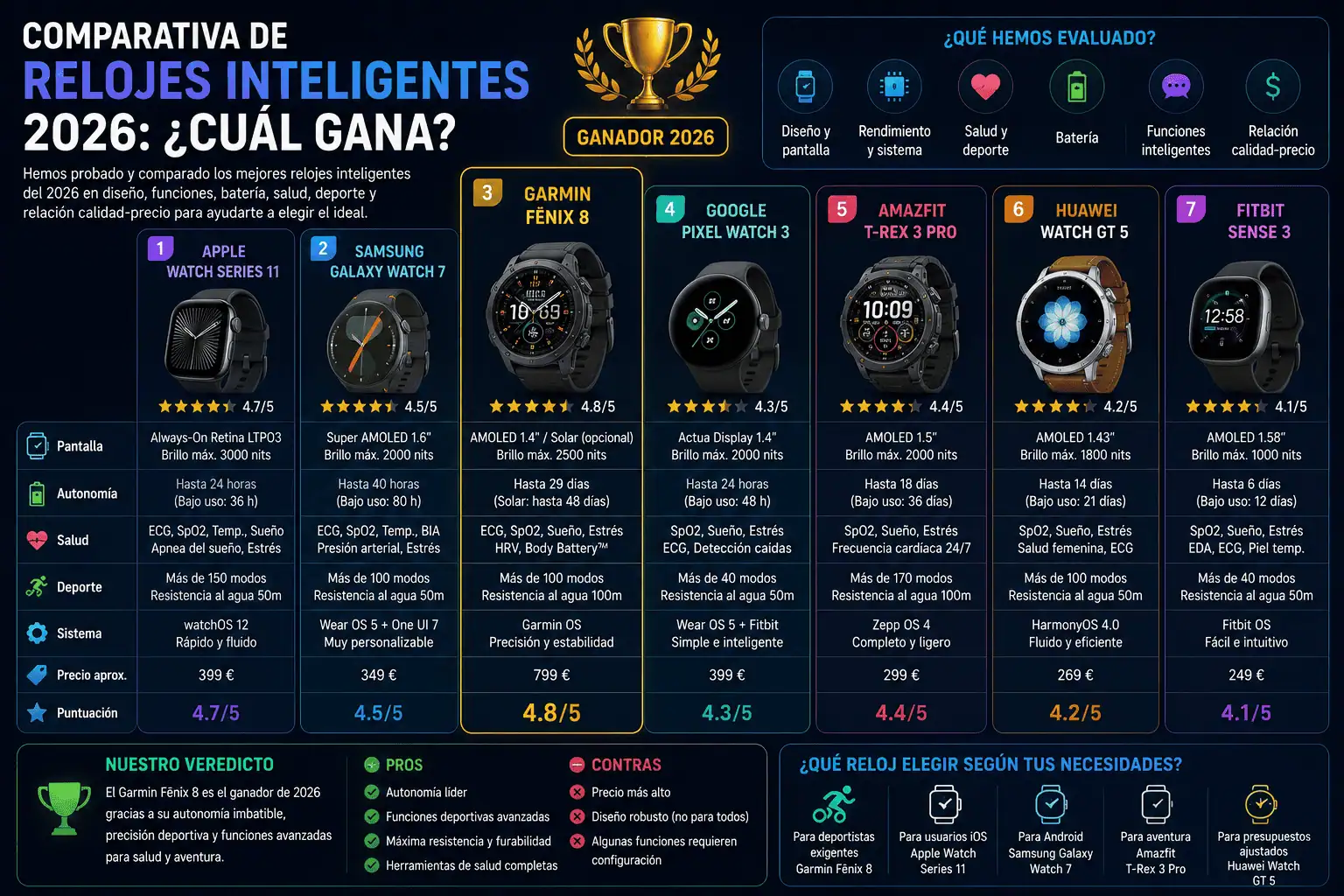
El mercado de los relojes inteligentes es dinámico y evoluciona constantemente gracias a los avances en el seguimiento de la salud, la potencia de procesamiento y la conectividad. Predecir cuál será el líder en 2026 requiere un análisis exhaustivo de las tendencias emergentes y las capacidades de los principales actores. Esta comparativa examina las propuestas de varias marcas líderes, centrándose en las funciones, la tecnología y la experiencia del usuario para anticipar qué reloj inteligente se convertirá en el rey.
Apple Watch Series 11 (Rumoreado): ¿Estableciendo el estándar, una vez más?
El Apple Watch siempre ha marcado la pausa en el mundo de los relojes inteligentes. Si se mantiene un ciclo de lanzamiento anual, podemos anticipar el lanzamiento del Apple Watch Series 11 en 2025. Las expectativas se centran en una monitorización de la salud mejorada y una mayor duración de la batería.
- Salud y Bienestar: La monitorización de la glucosa en sangre sigue siendo un objetivo prioritario. Si bien la miniaturización de los sensores presenta desafíos, en 2026 podría integrarse un método no invasivo de seguimiento de la glucosa, posiblemente análisis mediante espectral avanzado. La detección de la apnea del sueño podría volverse más sofisticada, yendo más allá de la simple oximetría para analizar las fases del sueño con mayor precisión, posiblemente incorporando la recopilación de datos de EEG mediante electrodos secos integrados en la pulsera. Se esperan mejoras adicionales en la monitorización del ECG y la presión arterial, quizás con lecturas de presión arterial sin calibración mediante fotopletismografía (PPG) avanzada. Los algoritmos de detección de caídas probablemente se perfeccionarán con IA más sofisticada, reduciendo los falsos positivos y proporcionando datos de ubicación más precisos para los servicios de emergencia.
- Rendimiento y tecnología: El chip personalizado de Apple representa una ventaja significativa. El chip S11 debería ofrecer un aumento considerable en el rendimiento, mejorando los tiempos de inicio de las aplicaciones y permitiendo un procesamiento en un segundo plano más complejo para el seguimiento de la salud. La pantalla podría experimentar mejoras adicionales, quizás adoptando una tecnología MicroLED para optimizar el brillo, el contraste y la eficiencia energética. También es probable que se implementen mejoras en la conectividad, incluyendo potencialmente una compatibilidad con Wi-Fi 7 más rápido y capacidades de banda ultraancha (UWB) mejoradas para un seguimiento del dispositivo más preciso y confiable.
- Software y ecosistema: watchOS seguirá siendo un factor diferenciador clave. Se espera una mayor integración con el ecosistema de Apple, una funcionalidad mejorada de Siri y una interfaz de usuario más intuitiva. Es probable que las aplicaciones de realidad aumentada (RA) tengan un papel más destacado, y que el Apple Watch funcione como dispositivo complementario para las gafas de RA. Es probable que la App Store experimente un aumento en las aplicaciones de salud y bienestar que aprovechan las capacidades mejoradas de los sensores.
- Diseño y personalización: Es poco probable que Apple modifique drásticamente el diseño, pero sí es probable que introduzca mejoras. Se esperan biseles más delgados, materiales más duraderos (posiblemente aleaciones de titanio o cerámica) y una mayor variedad de correas. También se podría explorar la modularidad, permitiendo a los usuarios intercambiar componentes como la batería o los sensores.
Samsung Galaxy Watch 8 (Rumoreado): El principal competidor de Android
La serie Galaxy Watch de Samsung es el principal competidor de Apple en el ecosistema Android. Es probable que el Galaxy Watch 8 se centre en mejoras similares, haciendo hincapié en el seguimiento de la salud y la duración de la batería.
- Salud y Bienestar: Samsung ha apostado fuertemente por ampliar sus funciones de salud. Se esperan mejoras en el ECG y la monitorización de la presión arterial, con la posibilidad de obtener la aprobación de la FDA para aplicaciones más amplias. El análisis de la composición corporal, mediante análisis de impedancia bioeléctrica (BIA), podría volverse más preciso y detallado, proporcionando información sobre la masa muscular, el porcentaje de grasa y los niveles de hidratación. La monitorización continua de la glucosa también es una función potencial, aunque aún existen importantes obstáculos tecnológicos. Es probable que las capacidades de seguimiento del sueño de Samsung se mejoren con un análisis más detallado de las fases del sueño y funciones de asesoramiento sobre el sueño.
- Rendimiento y tecnología: El Galaxy Watch incorpora los chipsets Exynos de Samsung. Se espera una mejora significativa en el rendimiento con el chip de última generación, optimizando el funcionamiento de las aplicaciones y permitiendo una gestión de energía más eficiente. La pantalla podría presentar mejoras en brillo y precisión de color. La tecnología de la batería será un aspecto clave, con la posibilidad de utilizar nuevos materiales o optimizaciones de software para ahorrar energía y así prolongar considerablemente su duración.
- Software y ecosistema: La plataforma Wear OS, desarrollada conjuntamente por Google y Samsung, será un factor clave de diferenciación. Se espera una mayor integración con los servicios de Google, una funcionalidad mejorada del Asistente de Google y una gama más amplia de aplicaciones disponibles en Google Play Store. Es probable que Bixby, el asistente virtual de Samsung, experimente mejoras adicionales, aunque su tasa de adopción sigue siendo inferior a la del Asistente de Google.
- Diseño y personalización: Samsung ofrece una gama de diseños más diversa que Apple. Se espera que esta tendencia continúe, con opciones tanto para estilos clásicos como deportivos. El bisel giratorio, un sello distintivo del Galaxy Watch, podría perfeccionarse aún más o incluso reemplazarse por un bisel táctil para un control más preciso.
Google Pixel Watch 3 (según rumores): una experiencia Android pura.
El Google Pixel Watch es relativamente nuevo en el mercado, pero el enfoque de Google en el software y la IA lo convierte en un fuerte competidor. Es probable que el Pixel Watch 3 haga hincapié en una integración perfecta con los servicios de Google y una experiencia de usuario personalizada.
- Health & Fitness: Google acquired Fitbit, and this acquisition will likely result in deeper integration of Fitbit’s health tracking technology into the Pixel Watch. Expect comprehensive activity tracking, detailed sleep analysis, and advanced heart rate monitoring. Google’s AI capabilities could be leveraged to provide personalized health insights and recommendations.
- Performance & Technology: The Pixel Watch will likely continue to use Exynos chipsets, but Google’s software optimization could provide a performance advantage. The display will likely be a bright and vibrant OLED display. Battery life remains a key area for improvement, and Google will likely focus on optimizing power consumption through software and hardware enhancements.
- Software & Ecosystem: The Pixel Watch runs Wear OS and offers a pure Android experience. Expect seamless integration with Google services like Google Assistant, Google Maps, and Gmail. Google’s AI-powered features, such as Smart Reply and Now Playing, will likely be further enhanced.
- Design & Customization: The Pixel Watch features a minimalist and elegant design. Expect refinements to the design, potentially with thinner bezels and a more durable build. Google will likely offer a range of band options to customize the look of the watch.
Garmin: The Specialist in Fitness and Outdoor Adventures
Garmin is a leader in GPS watches and fitness trackers. While not strictly a smartwatch, Garmin’s devices offer a compelling combination of fitness tracking and smart features. Garmin’s 2025 offerings will likely continue to emphasize durability, battery life, and advanced fitness tracking capabilities.
- Health & Fitness: Garmin’s strength lies in its comprehensive fitness tracking features. Expect advanced metrics for running, cycling, swimming, and other sports. GPS accuracy is a key differentiator, and Garmin will likely continue to improve its GPS technology. Battery life is also a major advantage, with some Garmin watches offering weeks of battery life on a single charge.
- Performance & Technology: Garmin’s proprietary software and hardware are optimized for fitness tracking. Expect improvements in processing power and sensor accuracy. Garmin Pay will likely be expanded to support more banks and countries.
- Software & Ecosystem: Garmin Connect is a comprehensive platform for tracking and analyzing fitness data. Expect further improvements to the Garmin Connect app and website. Garmin will likely continue to offer a wide range of watch faces and apps through its Connect IQ store.
- Design & Customization: Garmin offers a wide range of watch designs, from rugged outdoor watches to stylish everyday watches. Expect a continuation of this trend, with options for different wrist sizes and preferences.
Factores clave de diferenciación en 2025:
- Precisión en el seguimiento de la salud: La precisión y fiabilidad de los sensores de salud serán un factor diferenciador clave. Las empresas que puedan proporcionar datos de salud más precisos y fiables tendrán una ventaja competitiva.
- Duración de la batería: La duración de la batería sigue siendo una preocupación clave para los usuarios de relojes inteligentes. Las empresas que logren mejorar significativamente la duración de la batería serán muy valoradas.
- Ecosistema de software: La disponibilidad de aplicaciones y servicios es crucial. Las empresas con ecosistemas de aplicaciones sólidos atraerán a más usuarios.
- Integración de la IA: La integración de funciones basadas en inteligencia artificial, como información personalizada sobre la salud y notificaciones inteligentes, será cada vez más importante.
- Conectividad: Una conectividad fiable, que incluya conectividad celular y un buen rendimiento de Bluetooth, será fundamental.
Predicción del ganador:
Determinar un único “ganador” es un desafío, ya que las preferencias de los usuarios varían considerablemente. Sin embargo, es probable que el Apple Watch mantenga su posición de liderazgo gracias a su fuerte reconocimiento de marca, su perfecta integración con el ecosistema de Apple y su completo conjunto de funciones. El Galaxy Watch de Samsung seguirá siendo un fuerte competidor, ofreciendo una alternativa atractiva para los usuarios de Android. El Pixel Watch de Google tiene el potencial de revolucionar el mercado con su experiencia Android pura y sus funciones con inteligencia artificial. Garmin comenzará dominando los segmentos de fitness y actividades al aire libre con sus dispositivos especializados. En definitiva, el “ganador” será el reloj inteligente que mejor se adapta a las necesidades y preferencias individuales de cada usuario. La continua innovación y competencia en el mercado prometen avances emocionantes en la tecnología de los relojes inteligentes hasta 2025.