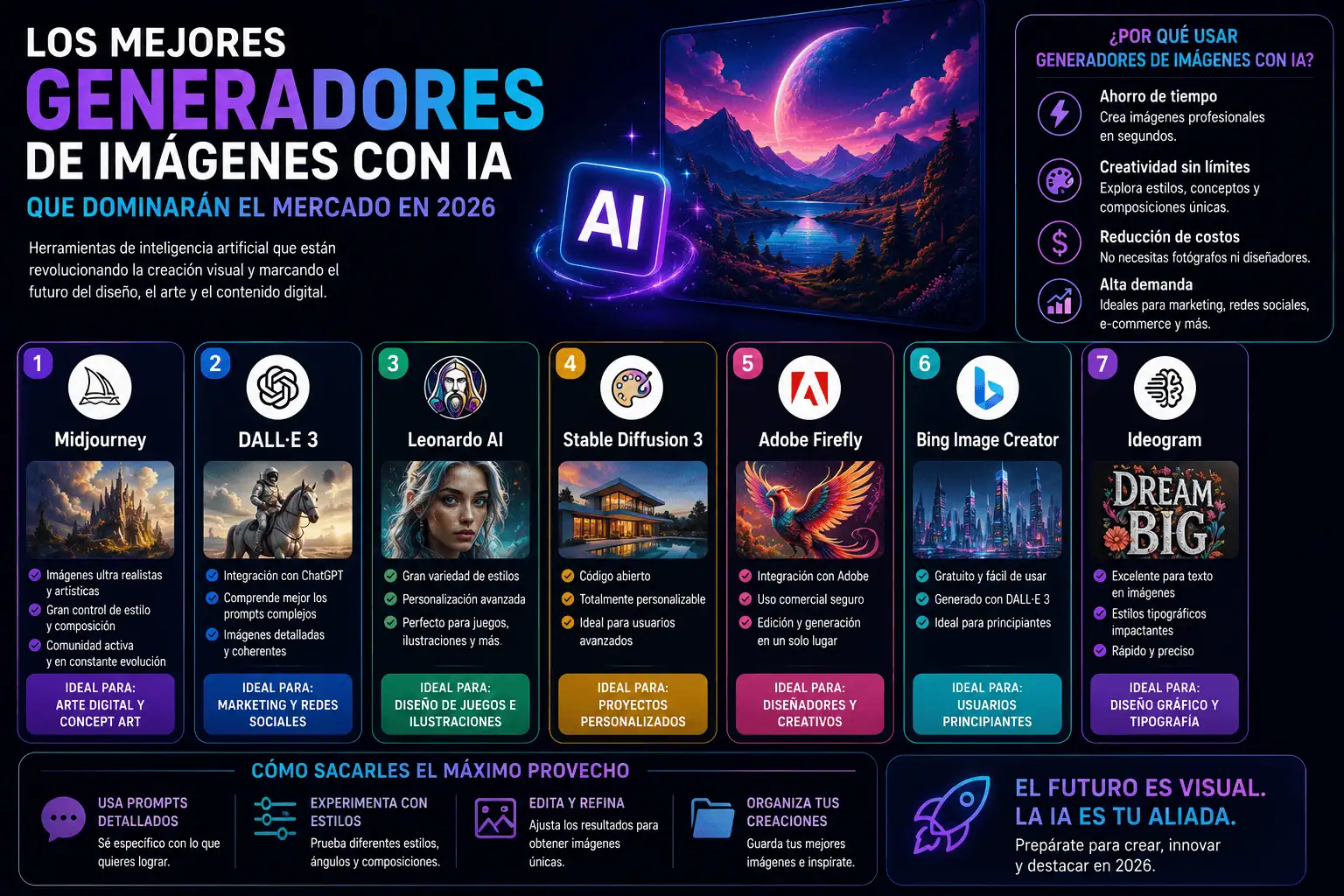
Los mejores generadores de imágenes con IA que dominarán el mercado en 2026: un análisis exhaustivo.
El panorama de la generación de imágenes mediante IA evoluciona a un ritmo vertiginoso. Lo que antes era una novedad, ahora es una poderosa herramienta utilizada por artistas, profesionales del marketing, diseñadores e incluso educadores. A medida que nos acercamos a 2026, varios actores clave están preparados para dominar el mercado, ampliando los límites del realismo, la creatividad y la accesibilidad. Este artículo profundiza en los generadores de imágenes con IA más prometedores, analizando sus fortalezas, debilidades, modelos de precios y posibles aplicaciones para ayudarle a desenvolverse en esta apasionante frontera tecnológica.
1. DALL-E 3 (OpenAI): El titán de la conversión de texto a imagen
DALL-E 3, integrado directamente en ChatGPT, representa un avance significativo en la comprensión y ejecución de indicaciones de texto complejas. Su principal fortaleza reside en su excelente precisión al interpretar las indicaciones. A diferencia de sus predecesores, DALL-E 3 reduce considerablemente la frustrante “alucinación de la IA”, es decir, la tendencia a malinterpretar o ignorar partes de una indicación.
Características principales:
- Integración directa con ChatGPT: Crea imágenes sin problemas dentro de tu flujo de trabajo actual de ChatGPT.
- Mejora de la comprensión de las indicaciones: Interpreta con precisión indicaciones complejas con detalles sutiles.
- Realismo mejorado: Genera imágenes de gran realismo, acercándose al fotorrealismo en ciertos casos.
- Coherencia de estilo: Mantiene un estilo consistente en múltiples generaciones de imágenes.
- Control creativo: Ofrece un control preciso sobre la composición, el estilo y el tema de la imagen.
- Medidas de seguridad: Mecanismos integrados para prevenir la generación de contenido dañino o inapropiado.
- Relleno/Relleno de imágenes: Edite las imágenes existentes añadiendo o eliminando elementos mediante indicaciones de texto.
Puntos fuertes:
- Precisión inigualable en la rapidez.
- Realismo y detalle excepcionales.
- Interfaz fácil de usar dentro de ChatGPT.
- Estrictos protocolos de seguridad.
- Mejoras continuas y actualizaciones de funciones por parte de OpenAI.
Debilidades:
- Depender del sistema de créditos de OpenAI puede resultar costoso para los usuarios intensivos.
- Existe la posibilidad de sesgo en las imágenes generadas, aunque OpenAI está trabajando activamente para mitigarlo.
- Dependiendo del caso de uso, pueden aplicarse restricciones de uso comercial.
Aplicaciones potenciales:
- Arte conceptual y creación de prototipos de diseño.
- Creación de material de marketing (publicaciones en redes sociales, elementos visuales para sitios web).
- Generación de recursos educativos (materiales visuales, ilustraciones).
- Creación de guiones gráficos y desarrollo de la narrativa visual.
- Arte personalizado y expresión creativa.
Modelo de precios: Sistema de crédito de pago por uso a través de OpenAI.
2. A mitad de camino: La vanguardia artística
Midjourney mantiene su reputación por generar imágenes artísticas impactantes, a menudo con una estética distintiva. Si bien no siempre son las más realistas, Midjourney destaca por crear obras de arte visualmente cautivadoras e imaginativas. Opera principalmente a través de un servidor de Discord, fomentando una sólida comunidad de artistas y aficionados.
Características principales:
- Estilo artístico único: Crea imágenes con una calidad pictórica y onírica.
- Interfaz basada en Discord: Accesible a través de un servidor de Discord dedicado, lo que fomenta la interacción de la comunidad.
- Ponderación de las indicaciones: Permite a los usuarios priorizar ciertas palabras clave dentro de sus indicaciones.
- Variaciones de imagen múltiples: Genera varias variaciones a partir de una sola indicación.
- Mejora de resolución: Aumenta la resolución de las imágenes generadas.
- Ajuste de parámetros: Ofrece una amplia gama de parámetros para ajustar con precisión la generación de imágenes.
- Exhibición de la comunidad: Anima a los usuarios a compartir sus creaciones y a proporcionar comentarios.
Puntos fuertes:
- Calidad artística y atractivo visual excepcionales.
- Fuerte apoyo y colaboración de la comunidad.
- Versátil para crear una amplia gama de estilos artísticos.
- Actualizaciones periódicas y nuevas funciones.
Debilidades:
- La interfaz basada en Discord puede resultar menos intuitiva para algunos usuarios.
- Puede resultar difícil lograr resultados específicos y muy realistas.
- El modelo de precios basado en suscripción puede no ser adecuado para usuarios ocasionales.
Aplicaciones potenciales:
- Creación de arte digital y generación de NFT.
- Diseño de portadas de álbumes y carteles.
- Ilustraciones conceptuales y arte fantástico.
- Creación de recursos para juegos.
- Encargos de arte personalizados.
Modelo de precios: Basado en suscripción con diferentes niveles de acceso y funciones.
3. Stable Diffusion XL (Stability AI): La potente herramienta de código abierto
Stable Diffusion XL (SDXL) es un generador de imágenes de IA de código abierto que ofrece una flexibilidad y personalización sin precedentes. Su naturaleza de código abierto permite a desarrolladores e investigadores modificar y adaptar el modelo a sus necesidades específicas. SDXL es conocido por su capacidad para generar imágenes de alta resolución con un nivel de detalle y realismo impresionantes.
Características principales:
- Modelo de código abierto: Disponible gratuitamente para su modificación y redistribución.
- Generación de imágenes de alta resolución: Produce imágenes con un nivel de detalle y una claridad excepcionales.
- Funcionalidades de conversión de texto a imagen y de imagen a imagen: Permite tanto crear imágenes a partir de texto como modificar imágenes existentes.
- Integración con ControlNet: Permite un control preciso sobre la composición y la estructura de la imagen.
- Capacidades de ajuste fino: Permite a los usuarios entrenar el modelo con conjuntos de datos específicos.
- Amplia red de apoyo comunitario: extensos recursos en línea y foros comunitarios.
Puntos fuertes:
- Altamente personalizable y adaptable.
- Genera imágenes de alta resolución.
- De código abierto y de uso gratuito (aunque el uso de recursos informáticos puede generar costes).
- Apoyo y desarrollo activo de la comunidad.
- Excelente para aplicaciones especializadas e investigación.
Debilidades:
- Requiere una considerable experiencia técnica para su configuración y uso eficaz.
- Requiere potentes recursos informáticos para un rendimiento óptimo.
- Puede resultar abrumador para los principiantes.
- Existe la posibilidad de que se haga un mal uso de su contenido debido a su naturaleza de código abierto.
Aplicaciones potenciales:
- Investigación y desarrollo en la generación de imágenes mediante inteligencia artificial.
- Soluciones personalizadas de generación de imágenes para sectores específicos.
- Experimentación artística y creación de imágenes innovadoras.
- Entrenamiento de modelos de IA personalizados.
Modelo de precios: Gratuito y de código abierto, pero requiere recursos informáticos (por ejemplo, instancias de GPU en la nube) que pueden generar costos. Stability AI también ofrece API comerciales para uso empresarial.
4. Adobe Firefly: El complemento de Creative Cloud
Adobe Firefly, integrado directamente en la suite Adobe Creative Cloud, busca integrar sin problemas la generación de imágenes mediante IA en los flujos de trabajo creativos existentes. Su objetivo es proporcionar a los profesionales creativos herramientas intuitivas para optimizar su proceso de diseño.
Características principales:
- Integración con Adobe Creative Cloud: Funciona a la perfección con Photoshop, Illustrator y otras aplicaciones de Adobe.
- Relleno generativo: Permite a los usuarios añadir, eliminar o reemplazar elementos en imágenes existentes mediante indicaciones de texto.
- Efectos de texto: Genera texto estilizado mediante inteligencia artificial.
- Generación de temas de color: Crea paletas de colores basadas en indicaciones de texto.
- Generación de gráficos vectoriales: Genera gráficos vectoriales a partir de textos introducidos.
- Credenciales de contenido: Garantiza la transparencia al adjuntar información de procedencia a las imágenes generadas.
Puntos fuertes:
- Integración perfecta con Adobe Creative Cloud.
- Interfaz intuitiva diseñada para profesionales creativos.
- Énfasis en el uso ético y responsable de la IA.
- Generative Fill es una potente herramienta para la edición de imágenes.
- Las credenciales de contenido promueven la transparencia y la confianza.
Debilidades:
- Los precios basados en suscripciones pueden resultar prohibitivos para algunos usuarios.
- Puede que no ofrezca el mismo nivel de flexibilidad artística que Midjourney.
- Todavía en desarrollo y en constante evolución.
Aplicaciones potenciales:
- Edición y manipulación de imágenes.
- Diseño gráfico y creación de marcas.
- Diseño web y desarrollo de interfaz de usuario/experiencia de usuario (UI/UX).
- Creación de material de marketing.
- Creación de contenido para redes sociales.
Modelo de precios: Integrado en los planes de suscripción de Adobe Creative Cloud.
5. Ideograma: El maestro de la tipografía
Ideogram se distingue por su especialización en la generación de imágenes con texto preciso y estéticamente atractivo. Esto la convierte en una herramienta indispensable para la creación de materiales de marketing, logotipos y diseños donde la tipografía es fundamental.
Características principales:
- Representación de texto excepcional: integra el texto en las imágenes generadas de forma precisa y estética.
- Generación de logotipos: Diseñado para crear logotipos visualmente atractivos con texto personalizado.
- Diseño de carteles: Ideal para generar carteles y material de marketing.
- Edición de indicaciones: Permite a los usuarios refinar las indicaciones y perfeccionar sus diseños.
- Compartir con la comunidad: Permite a los usuarios compartir sus creaciones con la comunidad de Ideogram.
- Interfaz sencilla e intuitiva: fácil de usar, incluso para principiantes.
Puntos fuertes:
- Capacidades de representación de texto inigualables.
- Excelente para el diseño de logotipos y carteles.
- Interfaz fácil de usar.
- De uso gratuito (con limitaciones).
Debilidades:
- La calidad de la imagen puede no ser tan alta como la de otros generadores de imágenes basados en IA.
- El enfoque en la tipografía limita su versatilidad para otros tipos de generación de imágenes.
- Es relativamente nueva en comparación con sus competidores ya establecidos.
Aplicaciones potenciales:
- Diseño de logotipos e imagen de marca.
- Creación de carteles y folletos.
- Gráficos para redes sociales con superposiciones de texto.
- Materiales de marketing.
Modelo de precios: Modelo freemium con una versión gratuita y planes de suscripción de pago para un mayor uso y más funciones.
Factores que configuran el futuro de la generación de imágenes mediante IA:
Varios factores influirán en la evolución de los generadores de imágenes de IA hasta 2025 y más allá. Estos incluyen:
- Mayor realismo y detalle: La búsqueda del fotorrealismo continuará, con modelos de IA que generarán imágenes cada vez más detalladas y realistas.
- Mayor comprensión de las indicaciones: la IA será aún mejor a la hora de interpretar indicaciones complejas y con matices, lo que dará lugar a resultados más precisos y predecibles.
- Mayor control creativo: Los usuarios tendrán más control sobre el proceso creativo, con la posibilidad de ajustar la composición, el estilo y el tema de la imagen.
- Integración perfecta con los flujos de trabajo existentes: Los generadores de imágenes basados en IA se integrarán cada vez más en las herramientas y flujos de trabajo creativos existentes, lo que los hará más accesibles y cómodos de usar.
- Consideraciones éticas: Las preocupaciones sobre los prejuicios, los derechos de autor y el uso indebido impulsarán el desarrollo de directrices éticas y medidas de seguridad.
- Democratización de la IA: La generación de imágenes mediante IA será más accesible a un público más amplio, lo que permitirá a particulares y pequeñas empresas crear imágenes de alta calidad.
- Modelos de IA especializados: Veremos el surgimiento de modelos de IA entrenados específicamente para aplicaciones de nicho, como imágenes médicas, visualización científica y renderizado arquitectónico.
A medida que nos acercamos a 2026, estos generadores de imágenes con IA seguirán evolucionando y ampliando los límites de lo posible. Comprender sus fortalezas y debilidades será crucial para quienes deseen aprovechar el poder de la IA en sus proyectos creativos.