Asistente de escritura con IA vs. escritor humano: ¿Cuál prevalece?
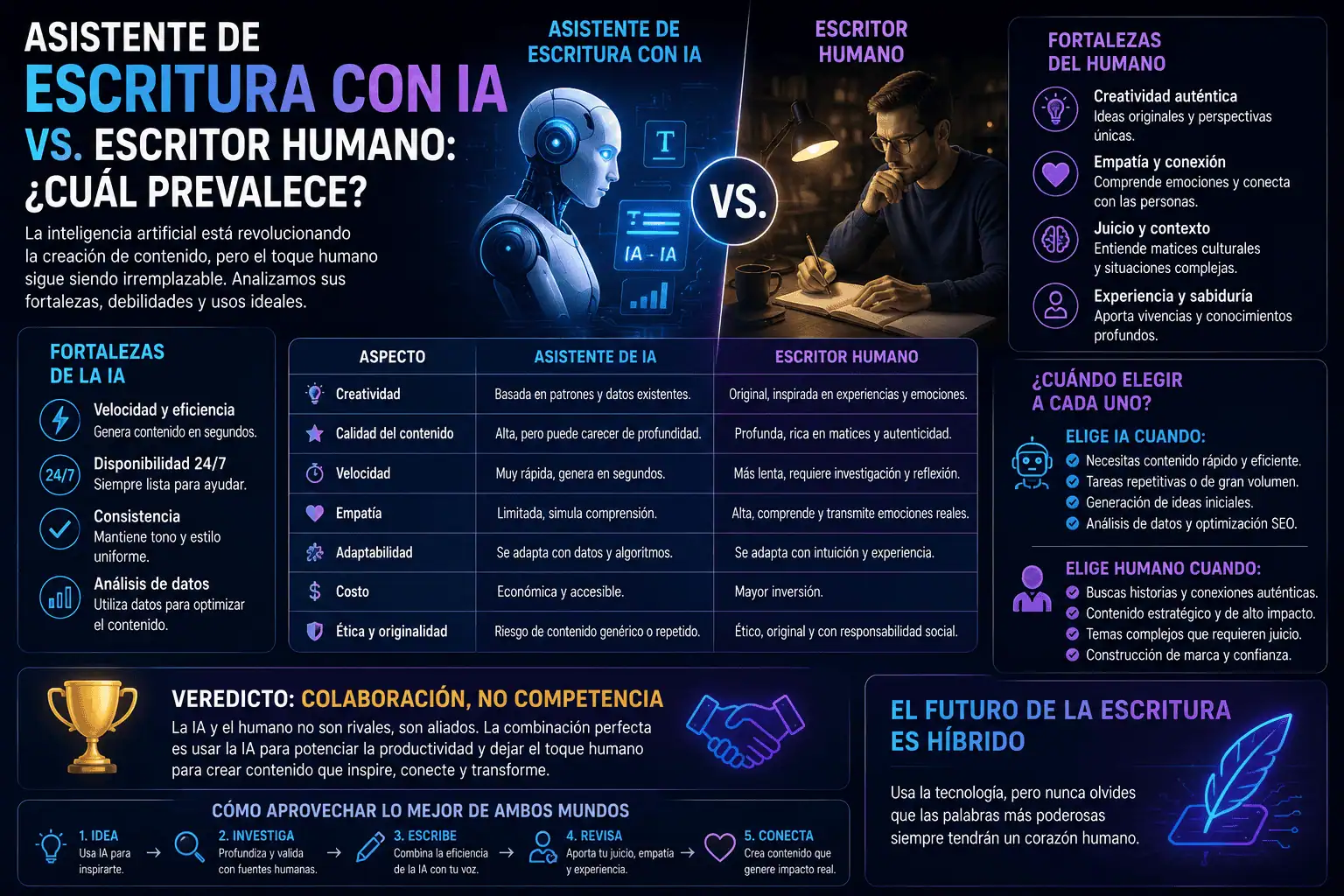
El panorama digital está experimentando una profunda transformación, impulsada por los rápidos avances en inteligencia artificial (IA). Este cambio es especialmente evidente en el ámbito de la creación de contenido, donde los asistentes de escritura con IA desafían cada vez más el dominio tradicional de los escritores humanos. El debate sobre el potencial de la IA para reemplazar o potenciar la creatividad humana es complejo y abarca cuestiones de calidad, originalidad, consideraciones éticas y la naturaleza fundamental de la autoría. Este artículo profundiza en las fortalezas y debilidades tanto de los asistentes de escritura con IA como de los escritores humanos, examinando diversos aspectos para determinar cuál de las dos entidades prevalece en el mundo de la creación de contenido.
Eficiencia y velocidad: la ventaja inigualable de la IA.
Uno de los argumentos más convincentes a favor de los asistentes de escritura con IA reside en su velocidad y eficiencia sin precedentes. Los algoritmos de IA pueden generar grandes cantidades de texto en cuestión de minutos, una hazaña imposible incluso para el escritor humano más habilidoso. Esta velocidad resulta especialmente beneficiosa para empresas y organizaciones que requieren grandes volúmenes de contenido, como descripciones de productos, textos para sitios web, publicaciones en redes sociales y artículos de noticias básicos. La IA puede automatizar tareas repetitivas, liberando a los escritores humanos para que se centren en proyectos más complejos y creativos.
Imaginemos un escenario en el que una empresa necesita generar miles de descripciones de productos para su tienda online. Un equipo de redactores humanos tardaría semanas, si no meses, en completar esta tarea. Un asistente de redacción con IA, en cambio, podría generar estas descripciones en una fracción del tiempo, reduciendo significativamente los costes laborales y acelerando el lanzamiento al mercado. Además, la IA puede operar las 24 horas del día, los 7 días de la semana, sin fatigarse, garantizando una producción de contenido constante independientemente de la hora.
Sin embargo, esta eficiencia tiene sus inconvenientes. Si bien la IA puede generar texto rápidamente, la configuración inicial y el ajuste fino del algoritmo requieren la intervención y la experiencia humanas. La calidad del resultado es directamente proporcional a la calidad de los datos de entrada y a la sofisticación del modelo de IA.
Creatividad y originalidad: El ámbito humano
Si bien la IA destaca por generar contenido de forma rápida y eficiente, a menudo se queda corta en cuanto a creatividad y originalidad. Los escritores humanos poseen la capacidad única de recurrir a experiencias personales, emociones y reflexiones para crear contenido verdaderamente atractivo y cautivador. Pueden adaptar su estilo de escritura a diferentes audiencias y propósitos, creando narrativas que conectan con los lectores a nivel emocional.
AI, on the other hand, relies on patterns and data that it has been trained on. While it can generate novel combinations of words and phrases, it often lacks the spark of originality that distinguishes exceptional writing. AI-generated content can sometimes feel generic, formulaic, and devoid of personality.
Human writers also possess a deeper understanding of nuance, irony, and humor, elements that are often lost in translation when AI attempts to replicate them. The ability to inject personality and wit into writing is a crucial aspect of engaging content, and it is an area where human writers maintain a significant advantage. Consider the creation of satire or parody – tasks that require a sophisticated understanding of social context and cultural references. AI, while capable of generating superficially humorous content, often struggles to grasp the underlying subtleties and complexities.
Accuracy and Fact-Checking: A Shared Responsibility
Both AI writing assistants and human writers can make mistakes. Accuracy is paramount, regardless of the source of the content. AI models are trained on vast datasets, which may contain inaccuracies or biases. Human writers, despite their best efforts, can also be prone to errors in research and fact-checking.
Therefore, rigorous fact-checking is essential for all content, regardless of whether it is generated by AI or a human writer. This process should involve verifying information from multiple sources, cross-referencing data, and consulting with subject matter experts. While AI can assist in the fact-checking process by identifying potential inconsistencies and inaccuracies, it cannot replace the critical judgment of a human editor.
The responsibility for ensuring accuracy ultimately rests with the content creator, whether that is a human writer or the individual or organization deploying the AI writing assistant. Failing to prioritize accuracy can lead to misinformation, reputational damage, and legal liabilities.
SEO Optimization: AI’s Data-Driven Approach
In the realm of search engine optimization (SEO), AI writing assistants offer several advantages. AI can analyze vast amounts of data to identify relevant keywords, trending topics, and optimal content structures. It can then generate content that is specifically tailored to rank highly in search engine results pages (SERPs).
AI-powered SEO tools can also assist in optimizing metadata, such as title tags and meta descriptions, to improve click-through rates. Furthermore, AI can monitor website traffic and engagement metrics to identify areas for improvement and refine content strategies.
However, SEO is not solely about keyword stuffing and algorithmic manipulation. Google and other search engines are increasingly prioritizing high-quality, engaging content that provides genuine value to users. While AI can assist in optimizing content for search engines, it cannot replace the need for well-written, informative, and entertaining content that resonates with human readers.
A human writer can weave keywords naturally into the text, creating a seamless and engaging reading experience. They can also understand the nuances of user intent and craft content that addresses the specific needs and questions of their target audience. A purely AI-driven approach to SEO can sometimes result in content that is technically optimized but lacks the human touch and emotional connection that drives engagement.
Ethical Considerations: Navigating the AI Landscape
The rise of AI writing assistants raises several ethical considerations. One of the most pressing concerns is the potential for plagiarism and copyright infringement. AI models are trained on existing content, and there is a risk that they may inadvertently generate text that is too similar to copyrighted material.
Another ethical concern is the potential for AI to be used to generate misleading or deceptive content. AI can be used to create fake news articles, propaganda, and other forms of disinformation. It is crucial to develop safeguards and ethical guidelines to prevent the misuse of AI writing assistants.
Transparency is also essential. When AI is used to generate content, it should be clearly disclosed to readers. This allows readers to assess the credibility of the content and to understand the role that AI played in its creation.
Ultimately, the ethical use of AI writing assistants requires a responsible and thoughtful approach. Developers, businesses, and individuals must consider the potential risks and benefits of AI and take steps to mitigate the negative consequences. The debate surrounding AI and authorship raises fundamental questions about originality, creativity, and the value of human expression. It is a conversation that we must continue to have as AI technology continues to evolve.
The Hybrid Approach: The Future of Content Creation
While the debate over AI vs. human writers often presents a binary choice, the most likely future scenario involves a hybrid approach. This model leverages the strengths of both AI and human writers, creating a symbiotic relationship where AI assists human writers in streamlining their workflow and enhancing their creativity.
In this hybrid model, AI can be used to automate repetitive tasks, such as research, fact-checking, and keyword analysis. Human writers can then focus on the more creative and strategic aspects of content creation, such as brainstorming ideas, crafting compelling narratives, and engaging with their audience.
Este enfoque permite a las empresas y organizaciones beneficiarse de la eficiencia de la IA, manteniendo al mismo tiempo la calidad, la originalidad y los estándares éticos del contenido creado por humanos. Además, permite a los escritores humanos adaptarse al panorama cambiante de la creación de contenido y desarrollar nuevas habilidades relevantes para la era de la IA.
El futuro de la creación de contenido no consiste en reemplazar a los escritores humanos con IA, sino en empoderar a los escritores humanos con herramientas y tecnologías de IA que les permitan crear contenido mejor, más atractivo y más eficaz.
En conclusión, si bien los asistentes de escritura con IA ofrecen ventajas significativas en términos de velocidad y eficiencia, los escritores humanos conservan la ventaja en cuanto a creatividad, originalidad y ética. La solución ideal reside en un enfoque híbrido que aproveche las fortalezas tanto de la IA como de los escritores humanos, creando una colaboración que impulse los límites de la creación de contenido.